Dedicated to the
Sovereignty of
Missourians

|
|
|
Dedicated to the
|
|
|||||
|---|---|---|---|---|---|---|---|---|
|
REASONS TO VOTE NO ON AMENDMENT 4 (Aug. 2026) 07/22/2026 Mofirst Position on IP Reform We don’t think we need “IP Reform” – instead we need “ratification reform” We support IP because I think it is an important tool for maintaining our constitutional republic. Core principles of an American constitutional republic
The People of Missouri “reserved” the power to use IP, “independent of the General Assembly” for the same reason they reserved the right to bear arms.
Some people do stupid or evil things with guns, but we all say it would be short-sighted and foolish to confiscate guns. The same is true of “political disarmament” of the people by taking away IP. The double standard in Amendment 4 is actually a power shift toward government. It’s like digging half the hole that mean dog needs to get under the fence. That said, we DO have a problem with too many and bad amendments to the Missouri Constitution. Over 81% of the amendments since 1910 were proposed by the legislature, including three dealing with bingo. The wrong legislature is a greater threat than IP. (A constitutional convention is an even larger threat!)
74% of the states recognize that threat and require super-majority votes of the legislature to propose amendments. Only 12 other states, besides Missouri, allow their legislatures to put an amendment on the ballot with just a simple majority vote.
All of that brings us to our core position on Amendment 4 and what we should be doing to protect our Constitution. We need to raise the bar on ALL proposed amendments, not just petition proposed amendments! Amendment 4 does not raise the bar where the greatest threat comes from, while it disarms the People.
|
DON'T FORGET THE THREAT OF CONSTITUTIONAL CONVENTIONS The iitiative petition and legialtive process can only change one piece of the Constitution at a time, but a constitutional convention could replace the entire Constitution in one fell swoop or propose dozens of individual amendments. About past conventions: https://www.mofirst.org/issues/ratification/Constitutional-Convention-History-in-Missouri.pdf |
May 6, 2010 -- General Assembly Attack on Citizen Lobbying! |
|
Missouri House votes to make non-registered citizen lobbyists felons! Download the short eval HERE. Missouri First eval of SB844 HERE. ALink to the bill: SB844!
|
Download: Missouri First eval of SB844 HERE. Download a PDF of SB844 with notes: HERE |
The Petition Rights Protection Act Submitted to SOS! |
|
Q. How long do you wait for the General Assembly to fix the problems with Missouri's petition process? A. Not one more moment! SB 818 seems hopelessly mired in politics. Although there are some fine statesmen, like Sen. Jim Lembke, there aren't enough to overcome the apathy or hostility toward the people's constitutional right to the petition process. That's why the Committee to Protect Petition Rights is seeking a solution "independent of the legislature", as Article III, Section 49 of the Missouri Constitution says. Their petition seeks to change the statutes in three primary ways: 1) Make respect for the voters the primary consideration in the petition processing procedure. The deadline for collecting almost 100,000 valid signatures is May, 2012. |
Downloads: |
Your Right to Petition for a Redress of Grievances Under Attack! |
|
End of Session Update: All the anti-citizen's initiatives died in the senate! Rep. Parson is running for the state senate, though, and if he is elected will probably push for the same restrictions from that side of the building. Update to Update: Rep. Parson won is bid for state senate. He will likely be in the senate for at least 4 years. Will he continue his attack on the petition process? There a handful of bills attacking your right to petition, but the ones that are moving through the legislative process are sponsored by Rep. Mike Parson. HB 1788 has passed the House and will have a hearing in the Senate elections committee on Monday, May 3rd! HB1788: Although the supporters of this bill claim that it is designed to keep out of state interests from coming to Missouri and changing our laws, it actually does nothing to that end. Instead, it hinders the right of Missourians to place an issue before the voters so they can decide. The bill arrogantly pre-supposes that voters can't be trusted. Here's what the bill does:
Prohibits out of state petition circulators Prohibits paying circulators based on performance Prohibits circulating more than one petition at a time The first two provisions have been repeatedly found unconstitutional when other states tried them and no other state has been arrogant enough to even try the last! This bill is clearly unconstitutional and designed to effectively end the petition process, not clean it up. Shame on you, Rep, Parson! What happened to your oath to support and defend the constitution? ACTION ITEM: Download the witness form in the right column and email it in so we can present it to the committee hearing on May 3. Rep. Mike Parson has also sponsored HJR 63 a constitutional amendment that will greatly increase the number of signatures required to place a question on the ballot. The increase difficulty and expense will take the petition process out of the reach of grass-roots efforts. This measure will get it's final passing vote in the House any day and then be sent to the Senate. |
Missouri Constitution Article III Section 49:
|
National, Socialized Medicine |
|
Upon the completion of the Constitution, Benjamin Franklin said:
"When the people find they can vote themselves insurance coverage, that will herald the end of the republic." Listen to the following interview in which Judge Napolitano explains why ObamaCare is unconstitutional and gives real solutions to this massive federal takeover of our personal liberty.
|
Lest we forget... In 2000, President Bush announced his prescription drug plan. It paved the way for ObamaCare. President Bush's No Child Left Behind Act of 2001 paved the way for President Obama's Race to the Top.
|
Get your "Concealed Weapons Encouraged" sign here. |
|
Missouri,
February 2009: A well regulated Militia being necessary to the security of a free State, the right of the people to keep and bear Arms, shall not be infringed. Please print and distribute freely! |
|
What is Mercantilism? |
|
“The economic policy dominant in the Europe of the seventeenth and eighteenth centuries, and christened "mercantilism" by later writers, at bottom assumed that detailed intervention in economic affairs was a proper function of government. Government was to control, regulate, subsidize, and penalize commerce and production. What the content of these regulations should be depended on what groups managed to control the state apparatus. Such control is particularly rewarding when much is at stake, and a great deal is at stake when government is "strong" and interventionist. In contrast, when government powers are minimal, the question of who runs the state becomes relatively trivial. But when government is strong and the power struggle keen, groups in control of the state can and do constantly shift, coalesce, or fall out over the spoils. While the ouster of one tyrannical ruling group might mean the virtual end of tyranny, it often means simply its replacement by another ruling group employing other forms of despotism. In the seventeenth century the regulating groups were, broadly, feudal landlords and privileged merchants, with a royal bureaucracy pursuing as a superfeudal overlord the interest of the Crown. “ From “Conceived In Liberty” -- Volume I A New Land, A New People: The American Colonies In The Seventeenth Century by Murray N. Rothbard |
Is mercantilism America's greatest threat? Mercantilism is also known as: “Fascism should more appropriately be called Corporatism because it is a merger of state and corporate power.” |
|
Property
Rights – Powers
of the State |
|
|
Missouri, 01/16/2006: That all political power is vested in and derived from the people; that all government of right originates from the people, is founded upon their will only, and is instituted solely for the good of the whole. (Art. I § 1) The very next section of the
Missouri Bill of Rights makes it clear that the “principle
purpose” of government is to make
sure these seminal principles are always honored. |
Current
eminent domain policy violates the basic concepts of the
separation of powers.
|
|
Property Rights – The Core Issue |
|
|
Missouri, 12/09/2005: An understanding of the heritage of the
American concept of property rights is necessary before we can
properly deal with that issue. Equipped with that understanding,
our concerns will go far beyond any individual neighborhood or
development – we will be concerned about the very
integrity of our system of constitutional governance. Any
social compact that permits the stronger, more powerful to
forcefully take the property of the weaker members of society
will eventually allow similar takings of “property”
of a more personal nature, like life and liberty. |
|
|
Missouri
Resolution to put Constitution Change on November Ballot |
|
|
Can you believe it? Our state is
the only one with a bicameral legislature that allows the Supreme
Court to hold impeachment trials! All other states, but
Nebraska, which is unicameral, and Oregon, which has recalls
rather than impeachment, allow one legislative branch to impeach
and the other, usually the senate, to hold impeachment trials. Of
course, the U.S. Constitution also provides for senate
impeachment trials. |
|
|
On
this page: |
News
|
|
U.S. Constitution Acknowledges God! We live in a time when a government agency or public school is very likely to face a constitutional challenge if it acknowledges God, so you might be surprised to find out that the United States Constitution itself acknowledges God. In fact, the constitution doesn't simply make an ambiguous reference to a generic “supreme being” – it honors Jesus Christ Himself, and submits the nation it defined to Him! “Where?”, you ask, “I've read the entire constitution and never noticed it.” It's there in unabridged copies and we'll take a look at it, but first a quick lesson in reckoning time. Practically every civilization has reckoned time relative to the the king in power during the referenced period. The Bible is replete with examples: “...in the fourth year of Solomon's reign over Israel, in the month of Ziv which is the second month, that he began to build the house of the Lord.” (1Kings 6:1) “Then work on the house of God in Jerusalem ceased, and it was stopped until the second year of the reign of Darius king of Persia.” (Ezra 4:24) This practice continues even today in many parts of the world. Until the post WWII Japanese constitution, the emperor was considered a sovereign, divine ruler. Although Emperor Hirohito was prompted by MacArthor to renounce that status, the practice of reckoning time by the current monarch continues. For instance, the year 2005 is officially year 17 of the Heisei Era of the Emperor Akihito. Until 2002, the Japanese Patent Office still used this system. It was no different right before the founding of the United States. The 1774 “Declarations and Resolves” by the Continental Congress complained of long running injustices from the mother country since “thirty-fifth year of the reign of King Henry the Eighth”. By April 19, 1775, however, the jaded colonists were distancing themselves from the current monarch, King George - that was the day of the “shot heard 'round the world” in Lexington, Massachusetts. In the town square that morning the King's Major Pitcairn was being faced down by about 70 colonists. He shouted, "Disperse, ye villains Lay down your arms in the name of George the Sovereign King of England". He was met with the response "We recognize no Sovereign but God and no King but Jesus!". The clarion call of the Revolution became “No King but Jesus!” The forthcoming Declaration of Independence hammered this point home by making it clear that man's rights did not come from an earthly king, but that they were “endowed by their Creator with certain unalienable Rights” and that “That to secure these rights, Governments are instituted among Men, deriving their just powers from the consent of the governed”. The Founders did not claim to be totally free from a king – just free from an earthly king! It was no coincidence that twelve years later the document that defined the new relationship between the states and defined the role of their general government would culminate with an acknowledgment that Jesus was their King! Article VII, known as the “subscription clause”, says the drafting of the Constitution was “done in Convention by the Unanimous Consent of the States present the Seventeenth Day of September in the Year of our Lord one thousand seven hundred and Eighty seven”. In other words, 1787 years into Christ's reign (since His birth) the Constitution was drafted. (Note: The Articles of Confederation, which preceded the Constitution, used the same terms.) Some will claim that “that's just the way people talked in those days”. They are right, in part, because it was more socially acceptable to honor God back then, but a look at other documents from that era proves that spelling out “the year of our Lord” was not routine. Virginia's constitution, for instance, fixed it's inception “on Monday the sixth day of May, one thousand seven hundred and seventy six”. How
can anyone who understands American history claim that it is
unconstitutional for the state to acknowledge God when that same
Constitution declares His Son King of the Land! |
|
What
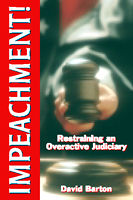
is impeachment? Impeachment is the constitutional process used by the legislature to ensure that the other two branches of government do not overstep their authority. Impeachment is the first of two steps used to remove an official who has subverted his office in some way. Being impeached is not being found guilty; it is not really even a trial, but only an effort to determine if a trial is called for, similar to a grand jury indictment. (More on the trial later.) First, understand that government derives it's power from the governed. The structure of American government is designed to make sure the people maintain ultimate control. Missouri government, like the federal government, is divided into three branches – the administrative, legislative, and judicial. Each branch is limited by the constitution to specific tasks, and each branch serves as a “check and balance” to the other two branches in order to ensure that no branch usurps the liberty of the citizens. Simply put, impeachment is the constitutional “weapon” the legislature uses to protect the liberty of the citizens and maintain it's own share of power among the three branches. Who can impeach a judge in Missouri? Missouri Constitution Article VII Section 2. “The house of representatives shall have the sole power of impeachment.” In addition to impeachment, the Missouri constitution provides for disciplining judges by the Commission on Retirement, Removal and Discipline of Judges (Article V, Section 24). The commission's purpose is to maintain the integrity of the courts, but not to maintain the balance of power among the three branches of government, so it is not the proper venue to deal with a judge who usurps the power of the legislature. Why does the power to impeach rest with the house of representatives alone? The legislature's power is divided among a much larger number of individuals, so the likelihood of despotic rule from that branch is relatively small – it is the body that is closest to the people. On the other hand, the power of the administrative and judicial branches resides with but a few men who are less accessible to the common man. Our representatives, like judges, have sworn to defend and uphold the constitution. Impeachment is a solemn responsibility neither to be shirked nor abused. What happens once articles of impeachment have been approved by the house? In Missouri, after the resolution passes the house, a trial ensues in one of two venues: 1) If a lower court judge is impeached, his trial is held before the state Supreme Court; 2) When the governor or a Supreme Court justice is impeached, the state senate selects a commission of seven jurists to hear the trial. The defendant can only be found guilty upon the concurrence of five sevenths of ether the court or commission. (MO Constitution, Article VII, Section 2) A judge is disqualified from acting as a judicial officer while articles of impeachment are being considered, but still receives his salary. (MO Constitution, Article V, Section 24.4) What are the possible penalties if found guilty? Missouri Constitution, Article VII, Section 3: “Judgment of impeachment shall not extend beyond removal from office, but shall not prevent punishment of such officer by the courts on charges growing out of the same matter.” James Wilson, an original justice of the U.S. Supreme court and signer of both the Declaration of independence and the U.S. Constitution said, “impeachments are confined to political characters, to political crimes and misdemeanors, and to political punishments.” Impeachment is neither a criminal procedure nor intended primarily for criminal offenses, so penalties are limited to removal from office. Judges removed from office also lose certain retirement benefits. (RSMo 476.480) (RSMo 476.560) (Entire Chapter 476) For what reasons can a judge be impeached? Missouri Constitution, Article VII, Section 1: “All elective executive officials of the state, and judges of the supreme court, courts of appeals and circuit courts shall be liable to impeachment for crimes, misconduct, habitual drunkenness, willful neglect of duty, corruption in office, incompetency, or any offense involving moral turpitude or oppression in office.” A court decision which is clearly in opposition to the plain meaning of the constitution made in favor of personal opinion or in deference to political allies is “corruption in office”. A decision like that is in violation of the judge's oath to defend the constitution and strikes at the seminal principles of “separation of powers”. If a the judge's motives are not malicious, but he simply misunderstands the clear dictates of the constitution, then he is guilty of “incompetency”. |
|
|
MO
Const. Article VII, Section 11: “Before taking office,
all civil and military officers in this state shall take and
subscribe an oath or affirmation to support the Constitution of
the United States and of this state, and to demean themselves
faithfully in office.” |
|
|
References: Missouri Constitution
Missouri Revised Statutes Search Missouri Revised Statutes
Directory of Missouri Representatives
|
|
|
|
Can you believe it? The Missouri constitution can be amended with a simple majority vote of an uninformed electorate! Maybe the next amendment to our state's supreme law should require a 2/3 vote for changes to this seminal document. |
|
|
|
UN
Flag Flying Over Missouri University! |
This
Land Is Your
Land?
The Problem With the UN Flag |
|
Why Do We Need Sovereignty for Missourians?
In the eyes of many Americans, the distinction between right and wrong has been blurred; our culture is changing faster than it ever has. Why is this, and what will be its end? THE SOURCE OF THE
PROBLEM |
|
|
|
|
|
|||
|
|
|||
|
Why Join Missouri First? Membership is Free! |
|
|
|
|
|
"Our citizens have wisely formed themselves into one nation as to others and several States as among themselves. To the united nation belong our external and mutual relations; to each State, severally, the care of our persons, our property, our reputation and religious freedom." -- Thomas Jefferson: To Rhode Island Assembly, 1801 |
|
|
Benjamin Franklin wrote in 1787: "Only a virtuous people are capable of freedom. As nations become corrupt and vicious, they have more need of masters." |
|
|
|
|
|
Copyright 2010 Missouri First, Inc. Home
- - Charter - -
Essays - - Projects - -
MO History - - MF News - |